
Verified May 2026
Perpetual DEX

Aster Invite Code

Use code 703d5E to claim a 5% lifetime fee discount plus airdrop eligibility on the Binance-backed multichain perpetual DEX with up to 1001x leverage

5% lifetime fee discount plus ongoing airdrop eligibility
703d5E

ReferralCoder may earn a commission when you sign up with this code, at no extra cost to you. Every code is tested personally to make sure you receive the maximum bonus available.

About the Aster invite code 703d5E

Aster is a multichain decentralized perpetual exchange formed in late 2024 through the strategic merger of Astherus (a multi-asset liquidity and yield protocol) and APX Finance (a decentralized perpetuals protocol). The merger unified yield-generating products with advanced derivatives infrastructure, addressing a long-standing inefficiency in DeFi: the separation of yield-bearing assets from trading collateral. Aster is backed by YZi Labs (Binance ecosystem); on 2 November 2025, Binance founder Changpeng Zhao (CZ) purchased 2 million ASTER tokens, triggering a 20% price jump and significant speculative attention.

By 2026 Aster reports 2 million users, $500+ billion in cumulative trading volume, ~$260 million in open interest, and ~$1 billion in total value locked. In September 2025 the platform briefly captured ~70% of global perpetual DEX trading volume before Hyperliquid reclaimed dominance by January 2026 (Hyperliquid now controls 70%+ of open interest). Aster operates across BNB Chain, Ethereum, Solana, and Arbitrum, plus the proprietary Aster Chain Layer 1 launched in March 2026 with zero-knowledge proofs and optional privacy features (stealth addresses).

The invite code 703d5E is the verified active code for May 2026. It unlocks two benefits. First, a 5% lifetime trading fee discount applied automatically across perpetual futures, spot, and tokenized real-world asset markets. Second, eligibility for ongoing airdrop campaigns including the Stage 6 ASTER token claims (opened 4 May 2026 with 310,000 tokens burned) and Au point rewards convertible to ASTER through trading volume, asUSDF staking, and platform engagement. The active RWA Sprint Season 1 (7 May to 7 June 2026) offers 0.9 basis point taker fees and 0% maker fees on 30+ stock, ETF, and commodity perpetuals.
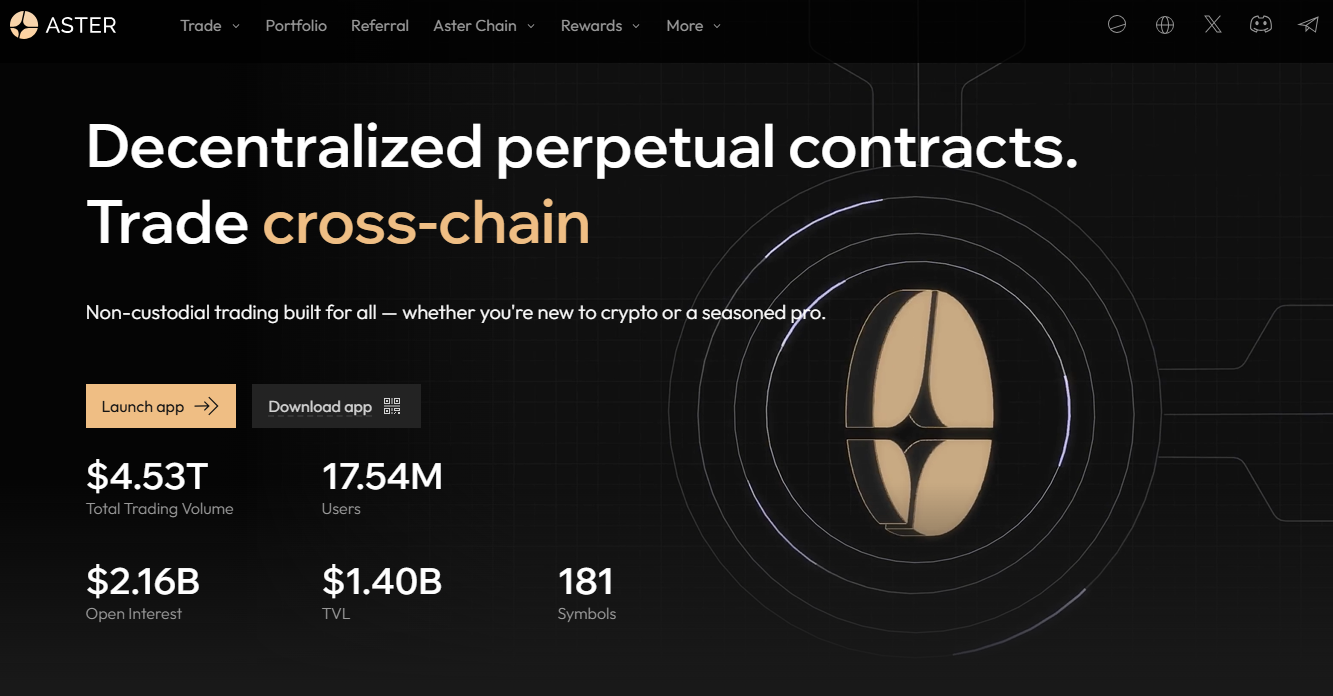
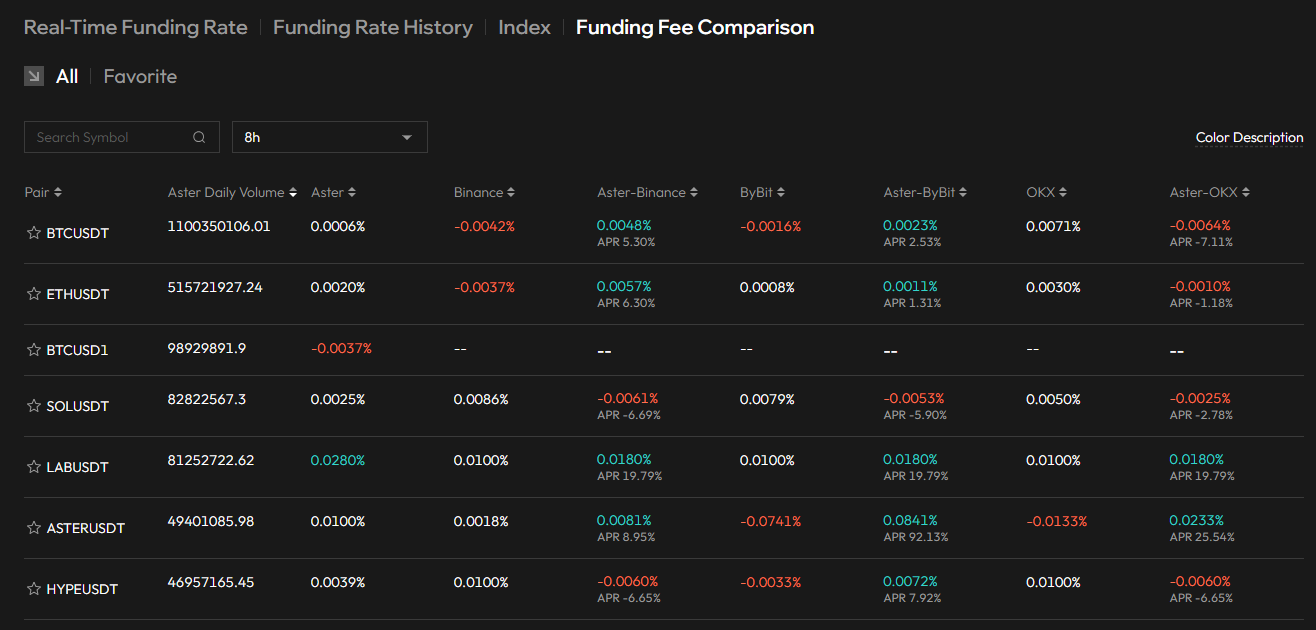
Aster DEX trading interface showing the multichain perpetual order book with Simple Mode 1001x leverage and Pro Mode with hidden orders

Aster invite offer at a glance

Invite code 703d5E
Fee discount 5% off all perpetual, spot, and RWA trading, for life
Airdrops Ongoing eligibility (Stage 6+ ASTER claims, Au point rewards)
RWA Sprint Season 1 0.9 bp taker / 0% maker on 30+ RWA pairs (7 May to 7 June 2026)
Base fees ~0.01% to 0.08% depending on mode/role
Maximum leverage Up to 1001x (Simple Mode), lower caps in Pro Mode and stock perps
Trading pairs ~96 spot/perp coins, plus tokenized stocks, gold, silver, FX
Trading modes Simple (1001x, ALP pool) and Pro (order book, hidden orders, grid)
Yield-bearing collateral asBNB (liquid staked BNB), USDF (yield stablecoin), asUSDF
Supported chains BNB Chain, Ethereum, Solana, Arbitrum, Aster Chain L1
Aster Chain Proprietary L1 with ZK proofs and stealth addresses (March 2026)
Users 2 million, $500B+ cumulative volume
TVL ~$1 billion
24h volume ~$1.32 billion (peak periods over $600M daily)
Custody model Non-custodial (user retains private keys)
KYC Not required (wallet-based access)
Backing YZi Labs (Binance ecosystem); CZ holds 2M ASTER (Nov 2025)
Validity Tested and active in May 2026

How to use the Aster invite code 703d5E

Onboarding is wallet-based. No email or KYC required.

  1. Install a supported wallet: MetaMask, Rabby, or Phantom (Solana). Secure your seed phrase offline; a hardware wallet (Ledger or Trezor) is recommended for substantial trading balances.
  2. Open Aster through the referral link or visit asterdex.com directly. Bookmark the official domain.
  3. Click Connect Wallet and approve the connection. Select the chain you want to trade on (BNB Chain, Ethereum, Solana, Arbitrum, or Aster Chain).
  4. When prompted for an invite code, enter 703d5E. The field appears during your first session.
  5. Deposit funds. Aster supports native deposits per chain; no bridging required because the platform operates natively across all supported chains.
  6. The 5% fee discount activates automatically.
  7. Choose your trading mode: Simple Mode (1-click, up to 1001x leverage, MEV-resistant via ALP pool) for fast scalping, or Pro Mode (order book, hidden orders, grid trading, advanced order types) for precision trading.
  8. Optional: deposit yield-bearing collateral (asBNB or USDF) via the Trade and Earn programme to earn yield while your margin is active.
  9. Track airdrop progress: Au points accumulate through trading volume, asUSDF staking, and platform engagement. Stage 6 claims opened 4 May 2026.

The invite code cannot be added retroactively to existing wallets. Aster is unsupported in sanctioned jurisdictions and operates outside major financial services regulatory frameworks.

Fee structure and the airdrop economy

Base fees (mode-dependent)

Aster's fees vary by mode and role, typically ranging from 0.01% to 0.08%. Pro Mode order book fees are usually lower for makers (providing liquidity) and modestly higher for takers; Simple Mode applies a pool-based fee model via the ALP liquidity pool. With code 703d5E applied, the 5% discount reduces effective fees by 5% across all modes.

RWA Sprint Season 1 (active 7 May to 7 June 2026)

Aster's active promotion campaign aggressively cuts fees on tokenized real-world assets to capture market share from both crypto-native and institutional traders:

  • 0.9 basis points (0.009%) taker fees on 30+ stock, ETF, and commodity perpetual pairs
  • 0% maker fees on the same RWA pairs
  • Markets covered: Tesla, Meta Platforms, Apple, Google, Microsoft, S&P 500 ETFs, gold, silver, and 20+ other commodities and ETFs
  • Combined with referral: the 5% discount reduces RWA taker fees to ~0.855 bp

Stage 6 Airdrop and Au points

The Stage 6 Airdrop claim window opened on 4 May 2026, with 310,000 ASTER tokens burned during the event (applying deflationary pressure on supply). Au points are Aster's ongoing rewards currency, accumulated through:

  • Trading volume. Au points scale with perpetual and spot trading activity.
  • asUSDF staking. Locking USDF mints asUSDF, which earns bonus Au points.
  • asBNB holdings. Liquid-staked BNB used as collateral earns staking rewards plus Au points.
  • Platform engagement. Liquidity provision to ALP, referrals, and special campaigns.

Au points convert to ASTER rewards distributed in subsequent airdrop stages.

Aster fee structure diagram showing Simple Mode pool fees, Pro Mode order book fees, RWA Sprint Season 1 0.9bp taker rates, and Au point accumulation flow

Token economics evolution

The ASTER token launched on 17 September 2025 and surged over 2,700% in the following weeks, peaking at $2.42 with a brief $3 billion market cap and $7 billion fully diluted valuation in November 2025. In 2026 Aster shifted emissions to a staking-only model, drastically reducing monthly token unlocks by 97% to reward long-term holders. This change is bullish for long-term token mechanics but reduced the easy farming yield that drove September 2025 adoption.

Conditions and validity for code 703d5E

  • New users only. Code must be entered during your first wallet connection. Cannot be applied retroactively.
  • Lifetime discount structure. The 5% discount continues for as long as the wallet remains active and linked to the referral.
  • Airdrop eligibility. Stage 6 claims opened 4 May 2026; ongoing Au points accumulate via trading and staking activity.
  • RWA Sprint Season 1. Active 7 May to 7 June 2026 with 0.9 bp taker / 0% maker fees on 30+ RWA pairs.
  • No KYC, no minimum deposit, no withdrawal limits beyond on-chain gas requirements.
  • Geographic restrictions. Sanctioned jurisdictions; users should verify local regulations before trading derivatives on a DEX.
  • Wallet security is your responsibility. Lost seed phrases cannot be recovered.
  • Decentralized exchange model. No traditional consumer protection, no centralized customer support beyond Discord and documentation.

Simple Mode vs Pro Mode: how trading works on Aster

Aster's dual-mode UX is one of the platform's clearest design decisions. Each mode targets a distinct trader profile with different mechanics, risk profiles, and ideal use cases.

Simple Mode (up to 1001x leverage)

  • One-click execution. Tap-to-trade interface optimised for speed.
  • MEV-resistant. Powered by the ALP (Aster Liquidity Pool); trades execute against pool liquidity rather than a public order book, reducing front-running and sandwich attack risk.
  • Up to 1001x leverage on select pairs (BTC, ETH). Lower leverage caps apply to other markets.
  • Pool-based fee model. Spread plus funding paid to ALP liquidity providers.
  • Best for: Aggressive scalpers, traders who want minimal friction, users new to on-chain derivatives.
  • Caveat: 1001x leverage is extreme; liquidation can happen in seconds during volatility. Most retail traders should never use this leverage tier with serious capital.

Pro Mode (order book, hidden orders)

  • Full CEX-style order book. Limit, market, stop, trigger, and conditional orders.
  • Hidden orders. A decentralized dark pool functionality: large orders can be hidden from the public order book to prevent slippage and front-running by market makers. This is unusual among perp DEXs and is Aster's sharpest competitive edge.
  • Grid trading. Built-in grid bot for ranging markets.
  • Advanced order types. Trailing stops, OCO, scaled orders, time-weighted execution.
  • Lower leverage caps than Simple Mode (typically 50x to 150x on major pairs, lower on RWAs).
  • Maker-taker fee model. Lower maker fees for liquidity provision.
  • Best for: Precision traders, larger positions, stock perpetuals, traders managing correlated exposures, anyone whose strategy depends on stealth execution.

The dual-mode design

Aster's dual UX represents a deliberate tradeoff. Simple sacrifices customization to provide guardrails, lowering operational friction. Pro trades ease of use for depth and capability. The Pro Mode order book with hidden orders forms the platform's sharpest UX edge: stealth execution on-chain is rare and valuable for institutional and large retail traders.

Markets, asBNB, USDF, and the Trade and Earn programme

Available markets

Aster supports ~96 spot and perpetual coins, plus a growing tokenized real-world asset catalogue:

  • Crypto perpetuals. BTC, ETH, SOL, BNB, plus major altcoins and meme coins via community proposals.
  • Spot trading. ASTER token dominates spot volume; popular pairs like BTC/USDT and ETH/USDT have thinner liquidity (around $6M daily).
  • Tokenized stocks. Tesla, Meta Platforms, Apple, Google, Microsoft, and major US equities as 24/7 perpetual contracts.
  • Tokenized commodities. Gold and silver as perpetuals with leverage caps lower than crypto majors.
  • Currency pairs. Selected FX perpetuals as Aster expands its RWA catalogue.

Aster Trade and Earn diagram showing asBNB liquid staked BNB and USDF yield-bearing stablecoin used as margin collateral while earning passive yield

asBNB and USDF: yield-bearing collateral

Aster's Trade and Earn programme allows users to post yield-bearing assets as margin collateral, letting their margin earn returns while perpetual positions are open. This is one of the platform's clearest innovations:

  • asBNB. Liquid-staked BNB that accrues BNB staking rewards (typically 2% to 5% APY depending on network conditions) while serving as collateral on Aster Pro Mode.
  • USDF. Yield-bearing stablecoin minted 1:1 against USDT. Reserves are held in Ceffu institutional custody. USDF generates yield via delta-neutral trading strategies and diversified DeFi yield sources, distributing weekly profits to asUSDF stakers.
  • asUSDF. Staking USDF mints asUSDF, a yield-bearing token. asUSDF holders earn bonus Au points convertible to ASTER rewards. This is the strongest passive income path on Aster for stablecoin holders.

The USDF design is more resilient than competitors like Ethena's USDe, which can struggle with negative funding environments. USDF diversifies into lending strategies to maintain returns when funding flips negative, providing better bear-market resilience.

Aster Earn additional features

Beyond Trade and Earn, Aster Earn supports staking for BTC, USDT, and CAKE with yearly yields above 30% on selected campaigns. These rates are unusually high and typically apply to limited allocations or promotional windows; the sustainable baseline is lower.

Aster Chain, decentralization, and the Binance dependency

Aster Chain Layer 1 (March 2026)

Aster Chain is the platform's proprietary Layer 1 blockchain, launched in March 2026 with zero-knowledge proofs and optional privacy features (stealth addresses). Aster Chain provides:

  • High-performance trading infrastructure with sub-second finality
  • Zero-knowledge proofs for compressed transaction validation
  • Stealth addresses for optional privacy on transfers and trades
  • Cross-chain bridging with BNB Chain, Ethereum, Solana, and Arbitrum
  • Native ASTER token as the gas and staking asset

The launch represents a graduation from EVM-compatible chain dependency to a purpose-built derivatives infrastructure, similar to Hyperliquid's proprietary L1 model.

Decentralization and self-custody

Aster is non-custodial. Users connect wallets, trade via audited smart contracts, and retain control of private keys at all times. As a result, Aster does not hold:

  • MiCA crypto-asset service provider licence
  • UK FCA, US CFTC, US SEC, or other tier-1 government authorisations
  • Mandatory KYC requirements

The Binance dependency

Aster's relationship with the Binance ecosystem is a double-edged sword. The positives are clear: YZi Labs backing, CZ's 2 million ASTER token purchase in November 2025, Binance listing of ASTER, and Ceffu custody for USDF reserves all provide credibility, distribution, and infrastructure. The negative is concentration risk: USDF reserves are held in Ceffu (a Binance-affiliated custodian), meaning Aster's flagship yield-bearing stablecoin has a direct dependency on Binance ecosystem operations. Any regulatory action against Binance or Ceffu, or service disruption affecting Ceffu custody, could directly impair core Aster platform functionality.

Market sentiment and adoption are also somewhat tied to public support from CZ. The 70% perp DEX market share peak in September 2025 happened during a period of intense CZ-related social media attention; that lead evaporated within months when Hyperliquid reasserted dominance. If Binance ecosystem backing diminishes, Aster's competitive position could weaken faster than fundamental product quality alone would suggest.

Operational track record and risks

Aster has not experienced major exploits or fund losses to date. The platform's audited smart contracts and rapid growth (2 million users, $500B+ volume) demonstrate operational capability. Known risks include:

  • Token dilution dynamics. Despite the 97% emissions reduction in 2026, ASTER supply still has unlock schedules that could pressure price.
  • Binance ecosystem dependency. USDF and platform sentiment both link to Binance.
  • Regulatory exposure. Derivatives DEXs with tokenized equities and 1001x leverage operate in a sector under growing global regulatory scrutiny.
  • Competition. Hyperliquid leads on depth and reliability; Aster needs sustained organic usage beyond incentives to maintain share.
  • Smart contract risk. Audited but not exploit-proof. Standard DeFi caveat.

Aster referral and affiliate program

Aster's referral programme provides referrers with a percentage of trading fees from invited users plus Au point bonuses. As a DEX, payouts happen on-chain in USDF or ASTER. Accepted high-volume affiliates can apply for custom commission tiers via the Aster Discord and community channels. The Rocket Launch programme provides additional rewards for new project participation and referrals.

About Aster

What is Aster DEX?

Aster is a multichain decentralized perpetual exchange formed in late 2024 through the merger of Astherus and APX Finance. The platform unifies yield-generating products with advanced perpetual trading infrastructure across BNB Chain, Ethereum, Solana, Arbitrum, and the proprietary Aster Chain Layer 1 (launched March 2026). Backed by YZi Labs (Binance ecosystem), Aster reached 2 million users, $500+ billion cumulative trading volume, and ~$1 billion TVL by 2026.

Main services on Aster

  • Perpetual futures. ~96 crypto perpetuals plus tokenized stocks, gold, silver, and FX pairs.
  • Simple Mode. 1-click MEV-resistant trading with up to 1001x leverage via the ALP pool.
  • Pro Mode. CEX-style order book with hidden orders (decentralized dark pool), grid trading, and advanced order types.
  • Spot trading. ASTER dominates spot volume; BTC/ETH spot pairs have thinner liquidity.
  • Tokenized stocks and RWAs. Tesla, Meta, Apple, Google, Microsoft, ETFs, commodities.
  • Yield-bearing collateral. asBNB (liquid staked BNB), USDF (yield stablecoin with Ceffu custody).
  • Trade and Earn programme. Yield-bearing margin via asUSDF staking with bonus Au points.
  • Aster Chain L1. Proprietary Layer 1 with ZK proofs and stealth addresses.
  • Aster Earn. BTC, USDT, CAKE staking with yields above 30% on selected campaigns.
  • Ongoing airdrops. Stage 6+ ASTER claims, Au point accumulation.
  • Rocket Launch. New project participation programme.

Why choose Aster?

Three reasons stand out. First, the dual-mode UX combining Simple Mode 1001x leverage with Pro Mode hidden orders (a decentralized dark pool functionality unusual among perp DEXs). Second, yield-bearing collateral: asBNB, USDF, and asUSDF let your margin earn returns while positions are open, with capital efficiency that few competitors match. Third, the multichain access without bridging: trade natively from BNB Chain, Ethereum, Solana, Arbitrum, and Aster Chain wallets. Plus, ongoing airdrop eligibility and the active RWA Sprint Season 1 with 0.9 bp taker fees on 30+ stock and commodity pairs.

The tradeoffs: Hyperliquid remains the dominant perp DEX by far (70%+ open interest vs Aster's smaller share by January 2026); Binance ecosystem dependency creates concentration risk for USDF; spot liquidity outside the ASTER token is thin; 1001x leverage is extreme and risky for most traders; regulatory uncertainty for high-leverage derivatives DEXs and tokenized equities. For experienced crypto-native derivatives traders who want yield-bearing collateral and multichain flexibility, Aster is a serious alternative to Hyperliquid. For users who prioritise depth, reliability, and proven track record, Hyperliquid leads.

Conclusion: is the Aster invite code worth using?

For anyone connecting a wallet to Aster in May 2026, code 703d5E is the right choice. The 5% lifetime fee discount is modest in isolation, but combined with airdrop eligibility (Stage 6+ ASTER claims, Au points convertible to rewards) and the active RWA Sprint Season 1 (0.9 bp taker fees on 30+ stock and commodity pairs through 7 June 2026), the cumulative value across the first months can be meaningful for active traders.

The bigger reason to consider Aster is the product differentiation. Pro Mode hidden orders provide decentralized dark pool functionality unusual among perp DEXs. Simple Mode 1001x leverage attracts aggressive scalpers (though most retail traders should never use this leverage tier). The yield-bearing collateral system (asBNB, USDF, asUSDF) combined with the Trade and Earn programme delivers capital efficiency few competitors match. Multichain access without manual bridging across BNB Chain, Ethereum, Solana, Arbitrum, and Aster Chain L1 is genuinely convenient.

The realistic recommendation: connect a hardware-secured wallet, register with the code, start with Pro Mode for serious trading (avoid 1001x leverage unless you fully understand liquidation dynamics), explore Trade and Earn with USDF for yield-bearing margin, and track Au point accumulation for airdrop eligibility. For users who want the deepest liquidity and most proven perp DEX, pair Aster with Hyperliquid; for fiat onramping before depositing crypto, use a MiCA-licensed CEX like Bitvavo or OKX.

Frequently asked questions

The verified Aster invite code is 703d5E. New users who register with this code unlock a 5% lifetime trading fee discount that applies across perpetual futures, spot, and tokenized RWA markets on Aster DEX, plus eligibility for ongoing airdrop campaigns and Au point rewards. The code is tested every month by Alex Mitchell.

No. Aster is a decentralized exchange and does not hold a MiCA crypto-asset service provider licence or any other tier-1 government regulator authorisation. As a multichain perpetual DEX operating across BNB Chain, Ethereum, Solana, and Arbitrum, plus the proprietary Aster Chain Layer 1, users retain custody of their funds via non-custodial wallets and trade via smart contracts. The platform is in a sector under growing global regulatory scrutiny due to its derivatives focus, tokenized equities, and high-leverage products.

Code 703d5E unlocks two benefits. First, a 5% lifetime trading fee discount that applies automatically across perpetual futures, spot, and tokenized real-world asset markets. Second, eligibility for ongoing airdrop campaigns including Stage 6+ ASTER token claims and Au points (which convert to ASTER rewards) earned through trading volume, asUSDF staking, and platform engagement. The discount activates when you connect a wallet and enter the code during your first session.

Aster DEX is a multichain decentralized perpetual exchange formed in late 2024 through the merger of Astherus (a multi-asset liquidity and yield protocol) and APX Finance (a decentralized perpetuals protocol). The merger combined yield-generating products with advanced perpetual infrastructure, creating a unified ecosystem for derivatives trading with yield-bearing collateral. Aster is backed by YZi Labs (Binance ecosystem). On 2 November 2025, Binance founder Changpeng Zhao (CZ) purchased 2 million ASTER tokens, triggering a 20% price jump and speculative interest. By 2026 Aster reports 2 million users, $500+ billion in cumulative trading volume, and ~$1 billion in total value locked.

Yes. Code 703d5E was tested and verified during the first week of May 2026 by registering through the official Aster DEX interface at asterdex.com. The 5% lifetime fee discount and airdrop eligibility are currently active. The Stage 6 Airdrop claim window opened on 4 May 2026 (310,000 tokens burned during the event), and the RWA Sprint Season 1 (7 May to 7 June 2026) is offering 0.9 basis point taker fees and 0% maker fees on 30+ stock, ETF, and commodity perpetuals.
Aster offers two trading modes with distinct mechanics. Simple Mode provides one-click MEV-resistant execution with leverage up to 1001x on select pairs (powered by the ALP liquidity pool), designed for fast scalping with guardrails. Pro Mode provides a full CEX-style order book with hidden orders (a decentralized dark pool functionality), grid trading, and advanced order types, designed for precision traders managing larger positions or correlated exposures. Stock perpetuals and Pro Mode have lower leverage caps than Simple Mode's 1001x ceiling.

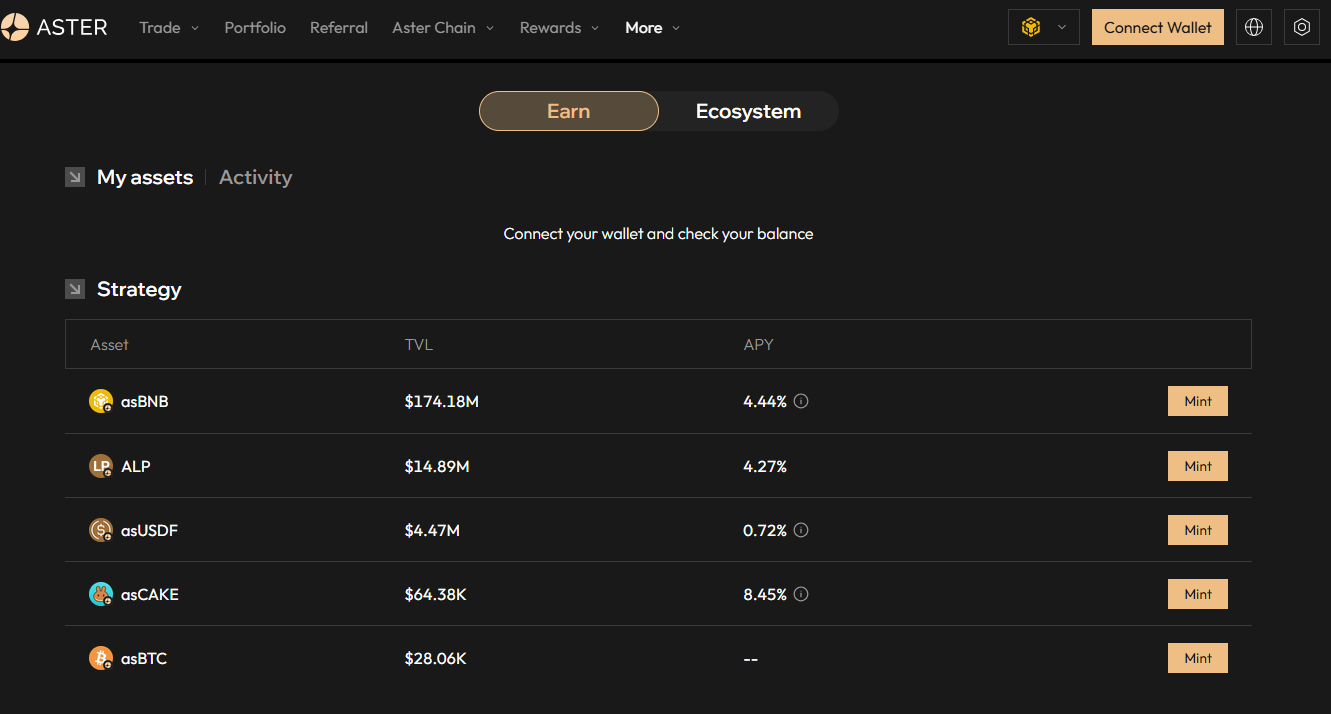
asBNB and USDF are Aster's yield-bearing collateral assets that let traders earn returns while their margin is active. asBNB is liquid-staked BNB that accrues BNB staking rewards while serving as collateral for perpetual positions. USDF is a yield-bearing stablecoin minted 1:1 against USDT, backed by delta-neutral trading strategies and diversified DeFi yield sources, with reserves held in Ceffu custody. Staking USDF mints asUSDF, which earns bonus Au points convertible to ASTER rewards. The Trade and Earn programme combines these yield-bearing assets with active derivatives trading for capital efficiency.

Aster is a non-custodial decentralized exchange with audited smart contracts. Users retain control of private keys via wallets like MetaMask or Phantom. The platform launched the proprietary Aster Chain Layer 1 in March 2026 with zero-knowledge proofs and optional privacy features (stealth addresses). The main risks are smart contract vulnerabilities (mitigated by audits), centralization dependencies (USDF mechanism relies on Binance/Ceffu infrastructure), regulatory uncertainty for high-leverage derivatives DEXs and tokenized equities, ASTER token dilution dynamics, and the user's responsibility for wallet security. The platform has not experienced major exploits or fund losses to date.