Verified May 2026
Crypto

Kraken Referral Code

Honest answer: there is no Kraken referral code in May 2026, and Kraken's fees are 30% to 60% higher than competitors. Here are three better alternatives with real codes and meaningfully lower trading costs.

No active referral code; high base fees (0.16% / 0.26%)

The honest answer: Kraken does not have a public referral code

If you searched for "Kraken referral code" you probably expected the same thing every other major crypto exchange offers: a code you enter at signup that gives you a permanent fee discount, a deposit bonus, or both. The honest answer is that Kraken does not run a public referral programme in May 2026. There is no code equivalent to Bybit's 50USD, Binance's GET20OFF, or OKX's GET20PERCENT. Sites that claim to have one are either showing an old US-only sign-up promotion that has since expired, or they're making something up.

The second honest answer is more important: even if Kraken had a 20% referral discount, its base fees are so much higher than competitors that you would still pay more than on Bybit, Binance, or OKX without any discount at all. The Kraken spot fee schedule is 0.16% maker and 0.26% taker for users below $50,000 in monthly volume. That is 60% more expensive than Binance and Bybit (both 0.10% / 0.10%) and roughly 50% more expensive than OKX (0.08% / 0.10%). After a 20% referral discount Kraken would still cost more than the standard rate on every major competitor.

This page exists because we get asked about Kraken often, and the only useful answer is the truthful one. If you want to use Kraken anyway (and there are valid reasons for that, covered further down), you sign up directly and pay the standard fees. If your priority is the lowest possible trading cost combined with a real welcome bonus, the three alternatives below are objectively better deals.
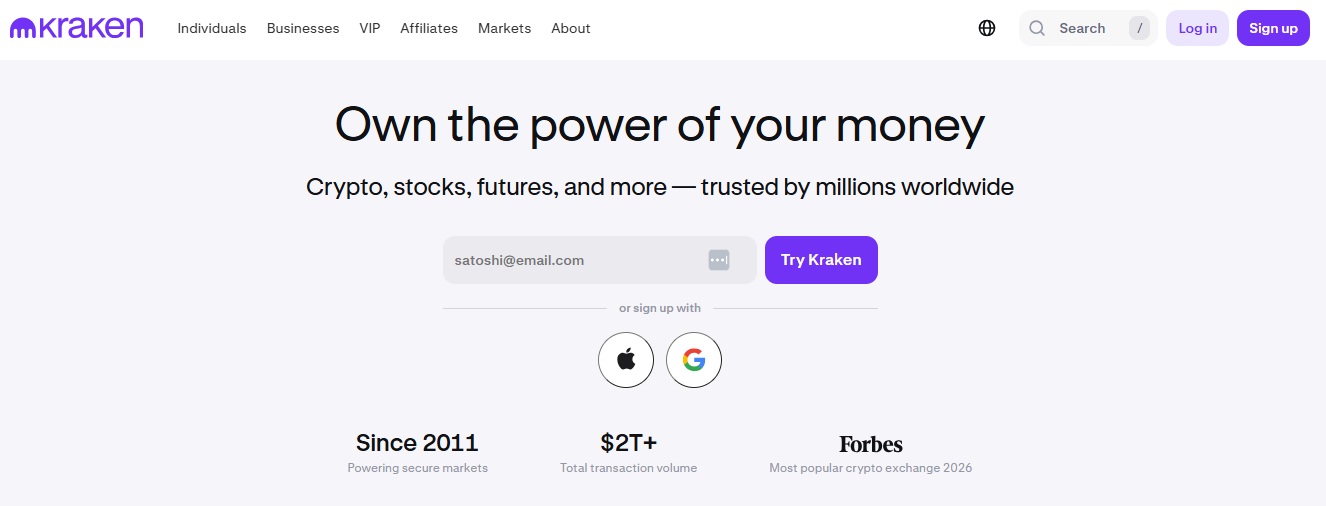
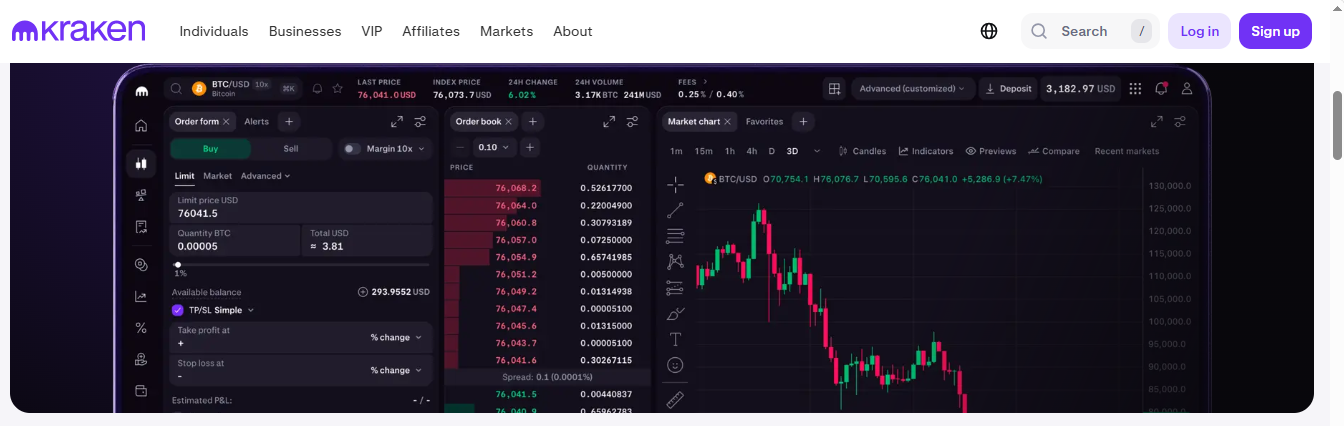
Visual showing the absence of a Kraken referral code with a comparison to the active codes on Bybit, Binance, and OKX

Three better alternatives with real referral codes

If you came here looking for a fee discount on a major exchange, these three are where to go instead. All have active referral programmes, base fees 30% to 60% lower than Kraken, monthly Proof of Reserves attestations, and either a US regulatory equivalent or a stronger global footprint.

Bybit (code 50USD): best for derivatives

Bybit is the second-largest crypto derivatives exchange globally and one of the few with a separate MiCA-licensed EU entity (Bybit EU, FMA Austria). The 50USD code unlocks $50 in free crypto after a $100 deposit, plus a 10% trading fee discount for 30 days on top of already-competitive 0.10% maker and 0.10% taker spot fees. Strongest reason to pick Bybit over Kraken: deep perpetual futures markets with up to 100x leverage, copy trading, grid bots, and substantially cheaper spot trading. Read the full breakdown on the Bybit referral code page.

Binance (code GET20OFF): biggest exchange, broadest product range

Binance is the largest crypto exchange in the world by trading volume across both spot and derivatives. The GET20OFF code unlocks a 20% lifetime spot fee discount. Base fees are 0.10% maker and 0.10% taker, dropping to 0.08% with the discount applied, plus an additional 10% off when paying fees in BNB. Strongest reason to pick Binance over Kraken: the 20% lifetime spot discount continues for the entire account lifetime, the platform serves 100+ countries (versus Kraken's narrower availability), and the BNB fee stack is among the cheapest in the industry. For derivatives traders specifically, Binance also offers a separate Binance Futures code (FUTURESOFF10) for 10% off all futures trades.

OKX (code GET20PERCENT): best for European regulated access

OKX holds a MiCA crypto-asset service provider licence and a MiFID II derivatives authorisation through MFSA Malta, making it one of the few non-US exchanges with both stablecoin spot and regulated derivatives access for European traders. The GET20PERCENT code unlocks a 20% fee discount plus 20 EUR in BTC after a 100 EUR deposit. Spot fees are 0.08% maker and 0.10% taker, the lowest of the three alternatives. Strongest reason to pick OKX over Kraken: regulated European access with MiCA-compliant stablecoin trading and the broadest cross-product fee discount of any major MiCA-licensed exchange.

Side-by-side comparison of Bybit, Binance, and OKX showing referral codes, welcome bonuses, base fees, and effective rates after referral discount

Kraken vs the alternatives at a glance

Platform Referral code Welcome bonus Spot fees (base) Effective with code
Kraken None active Occasional regional $20 only 0.16% / 0.26% No change (no code)
Bybit 50USD $50 free crypto 0.10% / 0.10% 0.09% / 0.09% (30 days)
Binance GET20OFF 20% lifetime discount 0.10% / 0.10% 0.08% / 0.08% (lifetime)
OKX GET20PERCENT 20 EUR in BTC (EU) 0.08% / 0.10% 0.064% / 0.08% (lifetime)

For a trader doing $10,000 in monthly spot volume, the difference between Kraken (no discount) and Binance with GET20OFF is roughly $18 per month or $216 per year. At $50,000 monthly volume the gap widens to roughly $90 per month or $1,080 per year. The savings compound further when you factor in the welcome bonuses, which Kraken simply does not offer at scale.

Why Kraken's fees are structurally higher

Kraken uses a maker-taker fee model with progressive volume tier discounts. The structure has two unusual features that combine to make it consistently more expensive than competitors at retail volume levels.

The inverted maker-taker ratio

Most exchanges set maker fees lower than taker fees to incentivise liquidity provision: a maker (limit order) gets a discount because they add liquidity to the order book, a taker (market order) pays slightly more because they remove liquidity. Binance is 0.10% / 0.10% (equal), Bybit is 0.10% / 0.10% (equal), OKX is 0.08% maker / 0.10% taker (standard ratio).

Kraken's spot schedule at the entry tier is 0.16% maker / 0.26% taker: the taker is higher than the maker (correct direction), but both are substantially higher than competitors. Where it gets unusual is that even with high volume discounts, Kraken's tier ladder takes longer to reach competitive rates. A trader needs to hit $10,000,000 in monthly volume on Kraken to get 0% maker fees; on Binance, a comparable maker rate is available much earlier through VIP tiers and BNB stacking.

The Kraken+ subscription wedge

In 2026 Kraken introduced Kraken+, a paid subscription that waives trading fees on the first $10,000 of monthly volume through the buy/sell/convert features (note: not on Kraken Pro, where serious traders actually trade). This is effectively a way to monetise the gap between Kraken's high standard fees and competitor fees: pay for the subscription and your fees become competitive again. The subscription costs $14.99 per month at launch, which means you pay roughly $180 per year for the right to get fee parity with what Binance or Bybit offer for free.

The staking commission

Kraken takes 15% to 25% of staking rewards as commission, depending on the asset and staking type. Flexible staking is subject to a 20% commission. Bitvavo charges 5% to 10% on most assets. Self-custody staking via a wallet costs 0% plus network fees. For a user staking $10,000 in ETH at a 4% gross APY, the difference between Kraken's 20% commission and Bitvavo's 7% commission is roughly $52 per year in net yield. Over multiple assets and multiple years, the gap matters.

When Kraken still makes sense

This page is critical of Kraken's fees because the fees are objectively high, but the platform is not a bad exchange. There are three specific cases where Kraken can still be the right choice.

  1. You are a US resident who values regulatory simplicity. Kraken holds money services licences in multiple US states and is registered as a Money Services Business with FinCEN. Binance is not available to US residents at all (Binance.US is a separate, more limited entity), and Bybit is restricted in the US. For users in the US who want a single platform that handles both crypto and (in supported states) US stocks under clear regulatory oversight, Kraken is a reasonable choice despite the higher fees.
  2. You trade US stocks alongside crypto. Kraken offers commission-free trading on 11,000+ US stocks and ETFs in supported US states. The convenience of a single platform for both asset classes can outweigh the higher crypto fees if your trading is not frequent. Note: this benefit is US-specific and does not extend to European users.
  3. You are a conservative long-term holder with strong views on safety. Kraken has not experienced any custodial wallet breach since 2011, which is one of the longest unbroken safety records in centralised crypto. Combined with monthly third-party Proof of Reserves audits, the platform has a stronger conservative-investor profile than younger venues. If you are holding BTC or ETH for years and rarely trade, the fee gap is less relevant.

If none of these three cases applies to you, the math favours moving to one of the three alternatives. For European users specifically, OKX (MiCA + MiFID II) and Bitvavo (MiCA, AFM Netherlands) are equally regulated alternatives with better economics. For derivatives traders, Bybit wins on cost, leverage, and product range.

About Kraken (the things they get right)

For balance: Kraken does several things genuinely well, and they deserve fair credit before this page closes with the bottom-line recommendation.

  • 14-year clean security record. No reported breach of customer custodial wallets since the platform launched in 2011. That is unmatched among centralised crypto exchanges of this age.
  • Third-party verified Proof of Reserves. Kraken was among the first major exchanges to publish independently audited PoR attestations and continues to do so on a regular cadence.
  • US regulatory positioning. Money Services Business registration with FinCEN, state money transmitter licences across most US states, separate authorisations in Canada and parts of the EU.
  • Asset breadth. 500+ cryptocurrencies plus 11,000+ US stocks and ETFs in supported US states, and tokenised stocks (xStocks) in some other jurisdictions.
  • Kraken Pro interface. The professional trading interface is clean, fast, and offers a respectable set of order types and analytics for active traders.
  • Customer support. Generally rated above industry average, with 24/7 live chat and reasonable response times even at the free account tier.
  • Margin and futures. Up to 50x leverage on perpetual futures, with a stronger US regulatory wrapper than most competing futures venues offer for US-eligible users.

The takeaway: Kraken is a reliable, well-regulated exchange. It is also one of the most expensive places to trade crypto in 2026 at retail volume levels. Both can be true at the same time.

Conclusion: skip Kraken, use one of these instead

If your reason for searching "Kraken referral code" was to save money on trades, the most honest answer we can give is: there is no Kraken code, and even if there were one, Kraken's base fees would still leave you paying more than on the alternatives. The fee structure is structurally 30% to 60% higher than Binance, Bybit, and OKX at retail volumes, and the absence of a real referral programme means there is no way to close that gap.

For most users we recommend the following routing:

  • Active trader who wants the deepest derivatives liquidity: Bybit with 50USD for $50 in free crypto, 10% off for 30 days, and 0.10% / 0.10% base fees.
  • Long-term holder with global access requirements: Binance with GET20OFF for a 20% lifetime spot discount on the world's largest exchange.
  • European trader who wants regulated derivatives: OKX with GET20PERCENT for MiCA + MiFID II access plus 20 EUR in BTC after a 100 EUR deposit.
  • European retail user who wants the simplest fiat onramp: Bitvavo with 431F1F for €10 free crypto plus €10,000 fee-free trading under MiCA.
  • US resident who needs Kraken's regulatory profile specifically: sign up directly on Kraken without a code (none exists). Be aware of the higher fees and consider Kraken+ subscription if you trade more than $1,000 per month through the simple buy/sell interface.

The fee math is unambiguous. For everyone except the small minority of users who specifically need Kraken's US regulatory wrapper or who actively trade US stocks alongside crypto, one of the four codes above will save you meaningful money every month for as long as your account is active.

Frequently asked questions

No. Kraken does not operate a public referral programme with a fee discount code in May 2026. Some users see occasional $20 sign-up promotions in specific US states, but these are time-limited regional offers, not a code that gives you a lifetime fee discount. There is no equivalent to the Bybit 50USD, Binance GET20OFF, or OKX GET20PERCENT codes on Kraken. If you are committed to using Kraken anyway, you sign up directly and pay the standard fees. The recommendation on this page is to use a competitor with both a code and meaningfully lower base fees.

Kraken's spot trading fees start at 0.16% maker and 0.26% taker for users below $50,000 in 30-day volume. This is unusual in two ways. First, it is significantly higher than competitors: Binance and Bybit are both 0.10% maker and 0.10% taker, OKX is 0.08% maker and 0.10% taker. Second, Kraken's maker fee is LOWER than its taker fee in absolute terms (the opposite of typical exchanges where makers pay less to incentivise liquidity provision). For a trader doing $10,000 in monthly volume, the difference between Kraken and Binance is roughly $16 to $26 in fees per month, which compounds to $200 to $300 per year. Active traders pay significantly more on Kraken than on any of the major alternatives.

Three exchanges consistently beat Kraken on fees, bonus structure, and product range while offering similar or better security profiles. Bybit (code 50USD) gives $50 in free crypto after a $100 deposit plus a 10% fee discount for 30 days on already-lower 0.10% base fees. Binance (code GET20OFF) gives a 20% lifetime spot fee discount on the largest crypto exchange globally. OKX (code GET20PERCENT) gives a 20% fee discount plus 20 EUR in BTC after a 100 EUR deposit for European users on a MiCA-licensed and MiFID II-authorised platform. All three are operationally robust with monthly Proof of Reserves attestations, deeper liquidity than Kraken on most pairs, and fee economics that comfortably undercut Kraken at every volume tier.

Yes. Kraken has operated since 2011 without any reported breach of customer-managed custodial wallets, which is one of the longest unbroken safety records in centralised crypto. The platform publishes third-party verified Proof of Reserves audits, holds money services licences in multiple US states and is regulated as a Money Services Business by FinCEN, has a UK FCA crypto-asset registration, and operates under MiCA in selected EU jurisdictions. Safety is not the reason to avoid Kraken. The reason is purely economic: you pay 30% to 60% more in trading fees than on Bybit, Binance, or OKX, with no offsetting referral discount available. For users where regulatory simplicity matters more than fees (US residents, conservative investors holding small portfolios long-term), Kraken can still make sense.

Yes. Kraken takes 15% to 25% of staking rewards as commission, depending on the asset and the staking type. Flexible staking on assets with an on-chain unbonding period is subject to a 20% commission. This is high by industry standards: Bitvavo charges 5% to 10% on most assets, Coinbase charges 25% to 35% (worse than Kraken), and self-custody staking via a wallet typically costs 0% plus network fees. If staking yield is a meaningful part of your strategy, the 15% to 20% Kraken commission compounds significantly over a multi-year holding period. Self-custody staking or a MiCA-licensed exchange with lower commission is usually the better option.

Yes, but that is a low bar. Coinbase charges up to 0.60% taker on its standard retail platform, which is among the highest fees in mainstream crypto. Coinbase Advanced (the pro interface) drops to 0.40% taker and 0.60% maker for low-volume users, still well above Kraken's 0.26% taker / 0.16% maker. So yes, Kraken is meaningfully cheaper than Coinbase. But both are significantly more expensive than Binance, Bybit, OKX, and most other modern exchanges. If your primary frame of comparison is Kraken versus Coinbase, you are choosing between two of the more expensive options in the market.

Occasionally, yes, but inconsistently. Kraken has run various $20 sign-up promotions for users in specific US states over the years, typically requiring a minimum deposit and first trade to claim. These are not the same as the bonus structures on Bybit ($50 free crypto), Binance (20% lifetime fee discount), OKX (20 EUR BTC + 20% off), or Phemex (up to $15,000), which run as ongoing referral programmes with documented terms. Kraken's promotional bonuses are time-limited regional offers that appear and disappear without consistent terms. For predictable, documented bonuses on top of much lower base fees, the major perpetual venues and MiCA-licensed competitors are stronger choices.

Use Kraken if you specifically value its US regulatory positioning (registered MSB, multiple state money transmitter licences, FCA registered in the UK), if you trade US stocks alongside crypto (Kraken offers commission-free US stock trading in supported states), or if you need a particularly conservative platform with a long unbroken safety record. Avoid Kraken if your primary concern is trading costs, if you trade actively with monthly volumes below $100,000, if you want a meaningful welcome bonus, or if you stake crypto frequently. For these majority cases, Bybit, Binance, OKX, or Bitvavo deliver substantially better fee economics, real referral discounts, and competitive security.